Therefore, when examining a doctrine or a teaching, it is Biblical and appropriate to ask, “Is this doctrine consistent with the nature of God as Jesus revealed it?”
It’s actually OK to not have all the answers yet.
In the context of the whole community, Scripture is rather specific: focusing on milk is a failure. We must grow up. We must eat meat, too.
Brothers and sisters, the Word of God is calling us beyond the safe “milk” topics. I intend to go there as I hear my Father bringing those topics up. But it’s the less-safe paths that lead to the really interesting destinations anyway.
There is more value tied up in US $20 bills than all of the other American bills combined, except the $100 bill. And of course, there is more value tied up in the US $100 bill than all other When things are valuable, they are counterfeited. When they are meaningless, they are not counterfeited.
Let
But for the terrorists, when they brutally murder a Christian, the demons that control him wrap their claws tighter around his soul. And when someone blows up a terrorist camp with a cruise missile, it is not to glory that the dead are destined, and it is most definitely not a flock of eager virgins that they will meet when they arrive. I was visiting with a friend the other day, talking about what God was up to on the earth today, and I envisioned this picture. (In Churchspeak, “I had a vision.”)
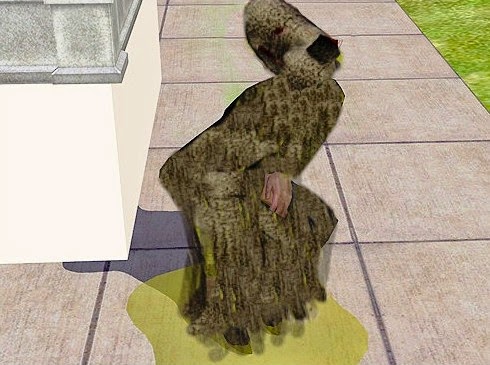
I saw the devil, and he was watching you. And as he saw you emerging from your hidden place, as he saw you beginning to walk in your identity as a child, as an heir, of God, as he watched you shake off “every weight, and the sin which so easily ensnares you,” I realized he was standing in a puddle. A yellow puddle. A warm yellow puddle.
Around the planet, the saints of God are coming out of their hiding places; they’re shaking off the snares of the enemy. Around the world, believers are beginning to believe, and are devouring the Word and learning who they really are, and what they’re really armed with. Around the Earth, wounded ones are healing the sick and raising the dead; some of them, without being healed themselves, are healing others in great numbers and with great determination.
And it’s scaring the piss out of hell.
This is one of the main reasons that “all hell is breaking loose” in some places: because all hell is terrified of the people of God growing from just being “Christians,” to becoming “Sons of God.” This is hell’s “fight or flight” mechanism kicking in, except that they have no place to run, nowhere to hide, so they have to fight.
This is also why we’re seeing so many earthquakes, so many storms, on the earth, in my viewpoint. These are the birth pains of the mature sons of God. And it’s also why so many believers are groaning, crying out for more, no longer content with sitting on a wooden pew once a week to be the primary manifestation of their relationship with God.
Romans 8 declares, “For we know that the whole creation groans and suffers the pains of childbirth together until now. And not only this, but also we ourselves, having the first fruits of the Spirit, even we ourselves groan within ourselves, waiting eagerly for our adoption as sons, the redemption of our body.”
This is happening today, right now. This is going on in you, today, right now. If you’re one of the ones wanting more of God – whether you want more of his presence, more healings, more people to know him, more signs and wonders: whatever! – then you’re one of the ones that are making the devil piss his pants.
Good for you! Keep up the good work! Don’t let down your guard, but keep pressing in! Keep manifesting heaven on earth!
——————————–
Nehemiah 4:17: “Those who built on the wall, and those who carried burdens, loaded themselves so that with one hand they worked at construction, and with the other held a weapon.”
Every so often, I hear someone moan wistfully, “If only we could return to the glory days of the first century church! If only we could be as full of faith as they were!”
I think if I hear that again, I’m going to scream.
May I speak plainly? That’s one of the stupidest spiritual-sounding things we could say in this day and age. I make the assumption that people who say that mean well, but come on! Let’s think about this a little bit:
The first century church, the church in the book of Acts, was a wonderful beginning. But they were only a beginning: this was the baby church, in diapers, as it were. I can tell you that I have no interest in going back to diapers. That would be such an epic failure, for the church of today to return to the “glory days” of the first century church! What was for them glorious success would be the worst of failures for us.
● “But,” someone will moan, “There were three thousand saved in a day!” That’s pretty good for rookies. Today, that’s less than an hour’s work in the Kingdom, and some reports suggest that’s closer to 20 minutes’ work.
Let us note that it only happened twice in the Book of Acts that three thousand were saved in a day. Today, more than three thousand people come to faith every single hour of every single day of every single year.
I’m thinking that’s an improvement.
● “But there were signs and wonders!” Somebody is seriously not paying attention. There were fewer than 20 miracles reported in the book of Acts, though there were repots of “lots of miracles.” Nowadays, we have lots of miracles on a regular basis.
I know one group that has a 100% success rate at healing the deaf, and nearly as good success healing the blind. I know two groups that won’t let people become elders unless they’ve raised someone from the dead. I know a group that legitimately calls themselves “The Dead Raising Team,” and they’re successful at it. I can’t tell you the number of successful healing teams I’ve heard about! They’re everywhere, and best of all, NOT just among the leaders, like the book of Acts.
Bethel Church in California reports thousands of documented miracles every time they send their students on outreach. And have you talked to the Healing Rooms movement recently?
Besides, I’m not sure I want more “Ananias & Sapphira events.” It’s my private opinion that even when that happened in Acts, it was an error, and not the will of God, but that’s another story. Surely it won’t be best for folks to fall dead in our meetings, when nobody can agree why it happened!
● “But they had all things in common!” I’ll grant that this is an area that we have room to continue growing in. But I am also aware that we’re talking about completely different cultures here. In that culture, if you couldn’t work, you starved to death. In our culture, the homeless guys on street corners make a (meager) living that in most of the world (or in the first century church) would be considered unmitigated wealth. (http://nwp.link/1s8woOt)
This does NOT mean that I propose that we stop helping the poor! Heaven forbid! This means I propose that we quit berating ourselves simply because we still have poor people among us: Jesus said we always would! (Matthew 26:11)
● “But they sold their homes! That’s dedication!” Well, some of them sold their homes. That was just good business; these were smart Jews! Jesus had clearly declared that the city would be destroyed shortly. It’s just good business to sell a house this week for full price that’s going to be destroyed with the city next week and be worth nothing! And clearly, if they “met house to house,” then not everybody sold their homes.
For the record, I know a bunch of people who’ve sold their homes for the ministry, several more than once. I know of others who sold themselves into slavery so that they could bring the good news to those in slavery, and they died in slavery. Most of these folks haven’t had books written about them, so they’re not known as well. But then Jesus taught us to keep quiet about our generosity, yes?
We could go on.
It is NOT my intent to disparage the excellent start that the Church had, as reported in the book of Acts. That was glorious.
What we have now is substantially more glorious. And that, too, is what we were promised. (See Isaiah 9:7)
This is one of the (several) reasons that I try to discourage people from asking every prophetic person they know for a prophetic word: prophecy is good (1Corinthians says it’s the most profitable of the revelatory gifts), but it’s still an inferior revelation to that which you can get just by visiting with the Son of God who lives in you!
I have a confession to make. I’ve been leading you astray. I’ve deceived you.
Let me explain.
I write, from time to time, about some of the interesting interactions that I’ve had with God, and about some of the interesting things I’ve discovered as I walk with him.
And that’s where the deception comes in.
I only write about the interesting stuff. I don’t write about the days and days of nothing in particular going on, because there’d be nothing to write.
Let me explain.
I’m a married man. More specifically, I’m a happily married man. Sometimes, Milady & I will spend the whole evening together in the same room, her reading, me writing, neither of us saying a thing. We’re just happy to be in each other’s presence. Seriously, I was in tears the other day, just thinking about growing old with her. It makes me really happy.
When I’m working in my garden, I can really often feel Father’s presence like that: quietly together. He’s taught me quite a lot there: how to transplant tiny seedlings, how to get more produce from a tiny garden, how to nurture the tender plants, and how, if I get the basics done well, the weeds won’t really be an issue.
I’m also a working man. And I gotta say that it’s not real often (though it does happen) that God speaks into the technical details of a project that I’m working on. And even when he does, I don’t write about it, because most of the story is about tweaky nerdly stuff that nobody outside my field is interested in. God showing me the right path to take a big bus through a crowded parking lot, or the best way to make these particular gears fit properly in a watch: this is not the stuff of interesting articles of faith and maturity.
But it is the stuff of real relationship with God.
I’m convinced that the best part of my relationship with God is not the amazing encounters or the awesome revelations or the impressive miracles. Yeah, those are fine, and I’ll not complain about them (this is a good place to say, “More Lord!” I think).
It’s like a good marriage: I love the times we get to go out to dinner, or where we host a barbecue for some friends, times of intimacy together. But the real strength of the marriage doesn’t come from those: it comes from the quiet, daily, almost ritual times together. We don’t have to talk about who’s turn it is to empty the dishwasher or take out the garbage or cook dinner, because we’re together.
And a love relationship with the Creator of the Universe is actually pretty similar: The fancy dinners are great, but quiet times of everyday life are where the real life & health come from.
So I apologize if I’ve left you with the impression that life in God is not all cool revelations and glorious highlights. Those happen, and they’re fun and all. But the day to day time together, not even really needing to form words: those are the places where the treasure’s found.
And those don’t make good stories to write about.
“Are they servants of Christ? (I am out of my mind to talk like this.) I am more. I have worked much harder, been in prison more frequently, been flogged more severely, and been exposed to death again and again.
The prophets declare the goal, solution, the finished product, the end result of God doing something in the person’s life. And sometimes they declare it as early as when God is just beginning work on the project. They’re “declaring the end from the beginning.” If you don’t know what you’re aiming for, how do you aim?
Before they were “Abraham and Sarah,” they were “Abram and Sarai.” They were on the first, and in some ways, the most amazing, adventure with God of all time.
Abe was the first guy to relate to God by faith (as opposed to Adam and company, who went for walks with God, and didn’t really need faith). Abe’s made it, by now, into the history books as The Father of Our Faith.
But it’s the story of Abe’s bride, Sarah, that inspires me today, though I’ll confess it’s from an odd perspective.
In Genesis 18, God promises Abe & Sarah, now old enough to be grandparents or great-grandparents, that they’d have a child, a son, next year. Abraham was a hundred years old; Sarah was ninety. There aren’t a lot of ninety year old women having babies even today with all the miracles of modern medicine.
But in those days? Not only unheard of, it was legitimately unthinkable. These guys knew and understood the birds and the bees. They knew there wasn’t a chance in the world of having a baby, and they’d made peace with that fact decades ago.
No wonder Sarah laughed. (“Therefore Sarah laughed within herself, saying, “After I have grown old, shall I have pleasure, my lord being old also?” ” Genesis 18:12. Apparently, by now they weren’t even doing the “pleasurable” things you do to get kids.)
Now here’s where it gets really interesting to me: God calls out Sarah for laughing at his promise (even though she only “laughed within herself”) and reaffirms the promise. And the best part (v15): Sarah lies to God about it “I did not laugh.” God, who apparently likes truth, called her on it again.
The story moves on to other interesting things, like God submitting his plans to Abraham, but that’s the part that caught my attention: Sarah essentially calls God a liar, and then when she’s exposed, she lies to his face. “Nope. Not me!”
Now skip ahead a couple of thousand years, to Hebrews 11, the “Hall of Faith.” These are the Heroes Of Faith, the great men and women that God holds up as examples of how to believe God. And Sarah is there! But this time, the story is told from God’s point of view:
“And by faith even Sarah, who was past childbearing age, was enabled to bear children because she considered him faithful who had made the promise. And so from this one man, and he as good as dead, came descendants as numerous as the stars in the sky and as countless as the sand on the seashore.” (Hebrews 11:11-12)
From Sarah’s perspective (and from Moses’ perspective, as he wrote the book), Sarah appears to have called God a liar, surely didn’t believe him, and then flat-out lied to him, to protect her reputation (or Abe’s).
And God calls that an act of faith. God sees that as “considering God faithful” and believing the promise. God apparently, from the phrase “and so” in v12, considers Sarah’s mighty faith to be the foundational reason that there was an Isaac and a Jacob and the Children of Israel.
If Sarah had been as full of unbelief as she sure looks like in Genesis 18, and as it appears she thought she was herself, then the story would stop right there. There’d never be anybody to Exodus out of Egypt, no Joshua, no David, and no Jesus.
So it occurs to me that we have kind of a messed up definition of what “faith” actually means. Read Hebrews 11 again, and read it carefully. These are not people that we’d normally consider giants of faith, at least not until Hebrews identifies them for us.
Noah, says Hebrews, “condemned the world and became heir of the righteousness that is in keeping with faith.” No he didn’t! He built a thing called a”boat” in a desert to preserve his family from some strange event that the Voice called a “flood.” He did it to save his life!
Moses “refused to be known as the son of Pharaoh’s daughter. He chose to be mistreated along with the people of God rather than to enjoy the fleeting pleasures of sin.” No he didn’t! He fled for his life, afraid the Egyptian cops would have heard about his murder when he tried to help an unfortunate slave out.
This is what sticks out to me: faith – real faith – doesn’t very often look heroic. There aren’t movie cameras rolling, and audiences watching as we Do The Mighty Deeds Of Faith.
That’s NOT at all what God refers to in his only chapter about Faith in the entire book.
Real faith seems to come with knocking knees, sweaty armpits and perhaps soiled undershorts. Real faith appears to sometimes be accompanied by laughing at God’s promises, doing stupid things for reasons you don’t understand, even screwing up in your good ideas of helping unfortunate people.
Here’s my takeaway: I’m going to try to not laugh at God so much anymore. But if I do, I’m not going to beat myself up over it. And if I feel really stupid for following a hunch, or for fowling up a good idea, I’m not going to beat myself up over those either.
And I’m going to try to not give up on God’s promises when it looks like there isn’t a chance in the world of them happening.
Just maybe, God’s writing those stories in his Book.