Letters

God Works Within Our Worldview

I'm sure you're aware that none, not a single one, of God's followers is perfect in everything we say, think and do? Amazingly, that includes you and me.

Did you realize that this didn't actually get in the way of God working with us and through us? Surprisingly, God does not expect absolute perfection from us the day that we first meet him.

It's not that God doesn't care about our shortcomings; he's just not disillusioned by the fact that we have them. He loves us anyway. He works with us anyway.

And while he works with us in our shortcomings, he doesn't leave us with those failures, doomed to eternal imperfection and unwitting brokenness. He relates to us in the broken, imperfect place, and he works through the broken imperfection to refine us, to make us more complete, to make us more like himself.

Take Abraham, for example. Abe grew up in Ur, an ancient Sumerian city-state in southern Mesopotamia (modern-day southern Iraq); he spent his first 75 years there [Genesis 12:4], so he was well and truly a child of the Sumerian polytheistic culture. Sacrifices were regularly performed to honor, appease, or seek favor from the gods, ensuring divine protection, fertility, and prosperity for the city and its people. The system included offerings of food, animals, and sometimes humans.

It was in the midst of that cacophony of deities that God speaks to Abe and tells him to leave the city. The problem is that Abe took 75 years of his history in the city with him when he left. He took the Sumerian culture with him.

So when God tells Abraham to head up the  mountain and sacrifice his son [Genesis 22:2], he didn't hesitate. In his experience, this is what gods did, so he assumed that the God that called him to leave the city demanded the same kind of sacrifice that the other gods demanded. Who was he to expect something different?

His adult son Isaac had not grown up in polytheistic Sumeria, but he'd grown up with polytheistic Abraham, so he didn't hesitate either. This is what gods demanded. Who are we to cross the gods?

And in the midst of both Abe and Zac complying with the call for a human sacrifice, God breaks in and interrupts the process. He provided a ram for the sacrifice and introduces himself as "Jehovah Jireh," The-LORD-Will-Provide (well, technically as "YHWH Yireh"). God was saying, "Abe, this is how you do things, but this is not how I do things. Let me show you how I do things: when I require something of you, I will be the provision for it. This is the God you're working with now."

The principle I take away from this is that God doesn't sweat the details: he works with us in whatever condition we're in, even while he restores our misshapen condition to a healthy place in him.

God and Abe had already been through this once before. In Genesis 15, God cut a covenant with Abe. He told him, "Bring me a heifer, a goat and a ram, each three years old." So Abe the Sumerian does what Sumerians do: he chops the animals in half. God didn't ask for that, but he rolled with Abe's traditions [H. C. Leupold, Exposition of Genesis, The Wartburg Press, 1972, p. 480].

I work with the assumption that none of us is perfect yet. And yet, I observe that God uses us to do his stuff in the Earth. Ergo, God works with imperfect people in our imperfect state, not offended by the imperfection, not even offended by the stupid things we believe about him.

Someone smart once said that "now I know in part, but then I will know fully [when the perfect has come]." Not a one of us "knows fully" yet. So God works with what we've got.

In other words, while we learn God's heart, his values, in the Bible, we would do best if we did not make the things that his people do in the Bible our standard. Not even the heroes (like Abe).

Apparently we do not need to chop animals in half or sacrifice our children in order to receive a promise from God. That's just they way Abe did it, largely because of his polytheistic Sumerian roots.

We probably don't need to seduce our friend's wife (and then put out a hit on our friend) like King David did in order to raise an heir to carry on the work God had given him. We probably don't need to kill church folk with our words like Peter did with Ananias and Sapphira when they lie about their generosity.  We could go on.

But wait, I can hear some folks say, won't that undermine the "Authority of the Word of God" in people's lives? Actually, no, though it probably will undermine the imagined authority of the religious leaders who control people with their Bible teachings. And that's not such a bad thing, is it?

You see, we were never designed to follow a written book as our guide for life, not even some leader's teachings about what the book says. The book was for the purpose of drawing us into relationship with a living God; we follow the living God. We continue to learn things from the Book that was written by earlier followers. And we can continue to learn from leaders whose goal is to serve the people of God rather than control them, assuming that they're following the living God and not just the teachings of other leaders who came before them.

Over the years, I've been teaching that unless we question our beliefs, we can never know if they're our beliefs, or if they're someone else's beliefs living in our head. This article is part of my questioning some of my historic beliefs, only to find that they were my denomination's beliefs, not mine.

It's hard to discover this, but it gives me the opportunity to get rid of my own false beliefs and learn more of what's actually true about my very real and very loving Father, who is not ashamed of my brokenness and ignorance.

Standard
Letters

So Many Rules!


I was thinking about the Old Covenant recently. Why were there so MANY laws and limitations?

I was reflecting that God had offered an AMAZING covenant relationship, very nearly the New Covenant way back then.

“‘Now therefore, if you will indeed obey My voice and keep My covenant, then you shall be a special treasure to Me above all people; for all the earth is Mine. ‘And you shall be to Me a kingdom of priests and a holy nation.’ These are the words which you shall speak to the children of Israel.” [Exodus 19:5-6]
 

The people chickened out, rejected that covenant, and proposed another covenant.

Then they said to Moses, “You speak with us, and we will hear; but let not God speak with us, lest we die.” [Exodus 20:19]

It was described more clearly in Deuteronomy:

“Go yourself [Moses] and listen to what the LORD our God says. Then come and tell us everything he tells you, and we will listen and obey.” [Deuteronomy 5:27]

I read that as the establishment of both the priesthood (“Moses, you go talk to God for us!”) and the Law (“You tell us what God says, and we'll do that!”).

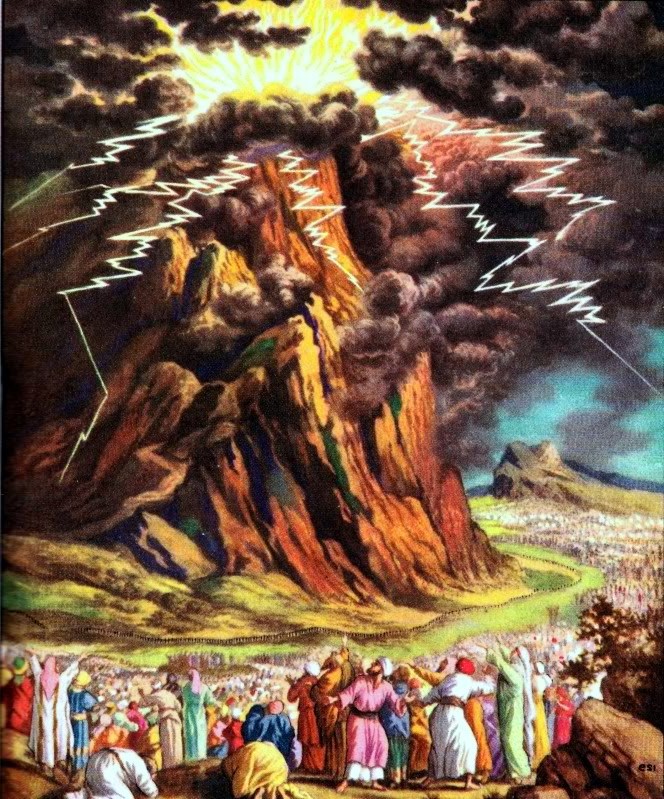
And immediately afterwards, there's a mountain of detailed rules and regulations.


My thought has been, “Why would God do that?”

And then I realized: the Law was never intended to be the vehicle for God to relate to people; it was the vehicle for the people to keep God at a safe distance.

So God spiked the punch.

God never intended for the Mosaic Law (“The Old Covenant”) to succeed at forming the relationship between God and man. God intended it to fail (it wasn’t his idea anyway), but in failing, to point to the New Covenant, which now needed to be delayed for a while, until the people were ready for it.

“The law was brought in so that the trespass might increase. But where sin increased, grace increased all the more.” [Romans 5:20]

“So then, the law was our guardian until Christ came, in order that we might be justified by faith. But now that faith has come, we are no longer under a guardian.” [Galatians 3:24-25]

From that first moment on the mountain in Exodus, God was already planning to make his people ready for REAL covenant, for the New Covenant in Christ.

Dang, he’s amazing.
Standard
Prophecy

Pioneer Movement Coming Forth in the Pacific Northwest Corridor

I believe there’s a pioneer movement coming forth in the Pacific Northwest Corridor. I recently saw a corridor of doors from Utah through Idaho into Oregon and Washington State. I heard it’s the corridor of doors that can become a corridor of glory! 

Each door represents a city that the LORD is knocking on their door (Revelation 3:20); will the remnant open the door and allow Him to come in and break the bread of Covenant Renewal. Will the remnant renew their wedding vows with The LORD - All My Life For Your Glory, Let My Life Be A Seed For A Harvest of Sons of Glory! 

If the remnant will renew their Covenant Vows of absolute surrender to the eternal purpose of God - Then and ‘Only Then’’ will they see the Revelation 4 door open. Psalm 24 becomes a possibility in 2024 if we will answer the summons!


Ed Watts,
Zion Gate Ministries, Flint, MI

Standard
Prophecy

Pioneer Movement Coming Forth in the Pacific Northwest Corridor

I believe there’s a pioneer movement coming forth in the Pacific Northwest Corridor. I recently saw a corridor of doors from Utah through Idaho into Oregon and Washington State. I heard it’s the corridor of doors that can become a corridor of glory! 

Each door represents a city that the LORD is knocking on their door (Revelation 3:20); will the remnant open the door and allow Him to come in and break the bread of Covenant Renewal. Will the remnant renew their wedding vows with The LORD - All My Life For Your Glory, Let My Life Be A Seed For A Harvest of Sons of Glory! 

If the remnant will renew their Covenant Vows of absolute surrender to the eternal purpose of God - Then and ‘Only Then’’ will they see the Revelation 4 door open. Psalm 24 becomes a possibility in 2024 if we will answer the summons!


Ed Watts,
Zion Gate Ministries, Flint, MI

Standard
Letters

Do Not Think That I Came to Destroy the Law or the Prophets

I’ve run into several people recently who quote Matthew 5:17, and use that to say that the OT Law is still valid. 

“Do not think that I came to destroy the Law or the Prophets. I did not come to destroy but to fulfill.” [MT 5:17]
 
They’re saying “Fulfilled means it’s still valid. You’re still obligated.”
 
Others say, “No, Fulfilled means it’s done, it’s concluded. It did its job, and now it’s over.”
 
So I thought, Let’s see how that word is used in other places in the Bible. That should give us an idea of what it means here.
 
So here’s a list. This is just part of the New Testament list, but the Old Testament use of the word is similar. (See the links to the full list in the footnotes)
 
Suggestion: For each verse, ask: “Does ‘fulfilled’ mean ‘It’s still in power; you’re still obligated’? or does ‘fulfilled’ mean ‘It’s done, concluded, and here’s the result’?”
 
Mat 2:15
where he stayed until the death of Herod. And so was fulfilled what the Lord had said through the prophet: “Out of Egypt I called my son.”
 
Mat 2:17
Then what was said through the prophet Jeremiah was fulfilled:
 
Mat 2:23
and he went and lived in a town called Nazareth. So was fulfilled what was said through the prophets, that he would be called a Nazarene.
 
Mat 13:14
In them is fulfilled the prophecy of Isaiah: “ ‘You will be ever hearing but never understanding; you will be ever seeing but never perceiving.
 
Mat 13:35
So was fulfilled what was spoken through the prophet: “I will open my mouth in parables, I will utter things hidden since the creation of the world.”
 
Mat 26:54
But how then would the Scriptures be fulfilled that say it must happen in this way?”
 
Mat 26:56
But this has all taken place that the writings of the prophets might be fulfilled.” Then all the disciples deserted him and fled.
 
Mat 27:9
Then what was spoken by Jeremiah the prophet was fulfilled: “They took the thirty pieces of silver, the price set on him by the people of Israel,
 
Mar 13:4
“Tell us, when will these things happen? And what will be the sign that they are all about to be fulfilled?”
 
Mar 14:49
Every day I was with you, teaching in the temple courts, and you did not arrest me. But the Scriptures must be fulfilled.”
 
Luk 1:1
Many have undertaken to draw up an account of the things that have been fulfilled among us,
 
Luk 1:38
“I am the Lord's servant,” Mary answered. “May your word to me be fulfilled.” Then the angel left her.
 
Luk 4:21
He began by saying to them, “Today this scripture is fulfilled in your hearing.”
 
Luk 18:31
Jesus took the Twelve aside and told them, “We are going up to Jerusalem, and everything that is written by the prophets about the Son of Man will be fulfilled.
 
Luk 21:24
They will fall by the sword and will be taken as prisoners to all the nations. Jerusalemwill be trampled on by the Gentiles until the times of the Gentiles are fulfilled.
 
Luk 22:37
It is written: ‘And he was numbered with the transgressors'; and I tell you that this must be fulfilled in me. Yes, what is written about me is reaching its fulfillment.”
 
Luk 24:44
He said to them, “This is what I told you while I was still with you: Everything must be fulfilled that is written about me in the Law of Moses, the Prophets and the Psalms.”
 
Jhn 17:12
While I was with them, I protected them and kept them safe by that name you gave me. None has been lost except the one doomed to destruction so that Scripture would be fulfilled.
 
Jhn 18:9
This happened so that the words he had spoken would be fulfilled: “I have not lost one of those you gave me.”
 
Jhn 19:24
“Let's not tear it,” they said to one another. “Let's decide by lot who will get it.” This happened that the scripture might be fulfilled that said, “They divided my clothes among them and cast lots for my garment.” So this is what the soldiers did.
 
Jhn 19:28
Later, knowing that everything had now been finished, and so that Scripture would be fulfilled, Jesus said, “I am thirsty.”
 
Jhn 19:36
These things happened so that the scripture would be fulfilled: “Not one of his bones will be broken,”
 
Act 1:16
and said, “Brothers and sisters, the Scripture had to be fulfilled in which the Holy Spirit spoke long ago through David concerning Judas, who served as guide for those who arrested Jesus.
 
Act 3:18
But this is how God fulfilled what he had foretold through all the prophets, saying that his Messiah would suffer.
 
Act 13:27
The people of Jerusalemand their rulers did not recognize Jesus, yet in condemning him they fulfilled the words of the prophets that are read every Sabbath.
 
Act 13:33
he has fulfilled for us, their children, by raising up Jesus. As it is written in the second Psalm: “ ‘You are my son; today I have become your father.'
 
Act 23:1
Paul looked straight at the Sanhedrin and said, “My brothers, I have fulfilled my duty to God in all good conscience to this day.”
 
--
Which is it?
 
Still in power; still obligated?
 
or
 
It’s done, concluded, finished?
 
-----
So here’s a list.
This is just part of the New Testament list (whole NT list: http://bit.ly/1MbLMaf),
but the Old Testament use of the word (whole OT list: http://bit.ly/1MbLMqF) is similar.
 

Standard
Letters

Do Not Think That I Came to Destroy the Law or the Prophets

I’ve run into several people recently who quote Matthew 5:17, and use that to say that the OT Law is still valid. 

“Do not think that I came to destroy the Law or the Prophets. I did not come to destroy but to fulfill.” [MT 5:17]
 
They’re saying “Fulfilled means it’s still valid. You’re still obligated.”
 
Others say, “No, Fulfilled means it’s done, it’s concluded. It did its job, and now it’s over.”
 
So I thought, Let’s see how that word is used in other places in the Bible. That should give us an idea of what it means here.
 
So here’s a list. This is just part of the New Testament list, but the Old Testament use of the word is similar. (See the links to the full list in the footnotes)
 
Suggestion: For each verse, ask: “Does ‘fulfilled’ mean ‘It’s still in power; you’re still obligated’? or does ‘fulfilled’ mean ‘It’s done, concluded, and here’s the result’?”
 
Mat 2:15
where he stayed until the death of Herod. And so was fulfilled what the Lord had said through the prophet: “Out of Egypt I called my son.”
 
Mat 2:17
Then what was said through the prophet Jeremiah was fulfilled:
 
Mat 2:23
and he went and lived in a town called Nazareth. So was fulfilled what was said through the prophets, that he would be called a Nazarene.
 
Mat 13:14
In them is fulfilled the prophecy of Isaiah: “ ‘You will be ever hearing but never understanding; you will be ever seeing but never perceiving.
 
Mat 13:35
So was fulfilled what was spoken through the prophet: “I will open my mouth in parables, I will utter things hidden since the creation of the world.”
 
Mat 26:54
But how then would the Scriptures be fulfilled that say it must happen in this way?”
 
Mat 26:56
But this has all taken place that the writings of the prophets might be fulfilled.” Then all the disciples deserted him and fled.
 
Mat 27:9
Then what was spoken by Jeremiah the prophet was fulfilled: “They took the thirty pieces of silver, the price set on him by the people of Israel,
 
Mar 13:4
“Tell us, when will these things happen? And what will be the sign that they are all about to be fulfilled?”
 
Mar 14:49
Every day I was with you, teaching in the temple courts, and you did not arrest me. But the Scriptures must be fulfilled.”
 
Luk 1:1
Many have undertaken to draw up an account of the things that have been fulfilled among us,
 
Luk 1:38
“I am the Lord's servant,” Mary answered. “May your word to me be fulfilled.” Then the angel left her.
 
Luk 4:21
He began by saying to them, “Today this scripture is fulfilled in your hearing.”
 
Luk 18:31
Jesus took the Twelve aside and told them, “We are going up to Jerusalem, and everything that is written by the prophets about the Son of Man will be fulfilled.
 
Luk 21:24
They will fall by the sword and will be taken as prisoners to all the nations. Jerusalemwill be trampled on by the Gentiles until the times of the Gentiles are fulfilled.
 
Luk 22:37
It is written: ‘And he was numbered with the transgressors'; and I tell you that this must be fulfilled in me. Yes, what is written about me is reaching its fulfillment.”
 
Luk 24:44
He said to them, “This is what I told you while I was still with you: Everything must be fulfilled that is written about me in the Law of Moses, the Prophets and the Psalms.”
 
Jhn 17:12
While I was with them, I protected them and kept them safe by that name you gave me. None has been lost except the one doomed to destruction so that Scripture would be fulfilled.
 
Jhn 18:9
This happened so that the words he had spoken would be fulfilled: “I have not lost one of those you gave me.”
 
Jhn 19:24
“Let's not tear it,” they said to one another. “Let's decide by lot who will get it.” This happened that the scripture might be fulfilled that said, “They divided my clothes among them and cast lots for my garment.” So this is what the soldiers did.
 
Jhn 19:28
Later, knowing that everything had now been finished, and so that Scripture would be fulfilled, Jesus said, “I am thirsty.”
 
Jhn 19:36
These things happened so that the scripture would be fulfilled: “Not one of his bones will be broken,”
 
Act 1:16
and said, “Brothers and sisters, the Scripture had to be fulfilled in which the Holy Spirit spoke long ago through David concerning Judas, who served as guide for those who arrested Jesus.
 
Act 3:18
But this is how God fulfilled what he had foretold through all the prophets, saying that his Messiah would suffer.
 
Act 13:27
The people of Jerusalemand their rulers did not recognize Jesus, yet in condemning him they fulfilled the words of the prophets that are read every Sabbath.
 
Act 13:33
he has fulfilled for us, their children, by raising up Jesus. As it is written in the second Psalm: “ ‘You are my son; today I have become your father.'
 
Act 23:1
Paul looked straight at the Sanhedrin and said, “My brothers, I have fulfilled my duty to God in all good conscience to this day.”
 
--
Which is it?
 
Still in power; still obligated?
 
or
 
It’s done, concluded, finished?
 
-----
So here’s a list.
This is just part of the New Testament list (whole NT list: http://bit.ly/1MbLMaf),
but the Old Testament use of the word (whole OT list: http://bit.ly/1MbLMqF) is similar.
 

Standard
Letters

The Grant Covenant


There are various types of covenants that could define relationship between people. Some are covenants among equals (such as a marriage covenant). Many are covenants between a superior and an underling.

One of those covenants between a superior and a lesser person is called a “Grant Covenant.” It is what it sounds like: the great person doesn’t negotiate, doesn’t require anything. They just grant the covenant. “Hold still and let me bless you.” The lesser person does nothing to deserve it.

This video is my second favorite example of a grant covenant (though of course, it’s not a perfect example).  Prince Edward does not ask anything of William, offers no conditions, no negotiation. He just frees him from prison and makes him a knight in the kingdom of his father. He doesn’t even ask Will’s permission.  Will could have refused it, I suppose, but there was no negotiation here.


That reminds me of my most favorite example of a grant covenant, and this one IS a perfect example:

“Jesus Christ… has made us kings and priests to His God and Father, to Him be glory and dominion forever and ever.” [Revelation 1:5&6]

King Jesus also does not offer any conditions, no negotiation. He just frees us from prison and makes us, not knights, but “kings and priests,” heirs of the Kingdom of our Father. He doesn’t even ask our permission. Yeah, you can refuse it I suppose (at least for a while; he can be very persuasive), but there has been, and will be, no negotiation.

Note that this grant covenant is pretty much the covenant that God offered the children that Moses led out of Egypt [see Exodus 19:6], which they rejected in favor of a less scary covenant.

And the more I learn about this Kingdom that I’ve been granted a position in, the more I understand why they thought it was scary. There is an obligation that comes with real authority. It changes us.

We are no longer slaves, so acting like a slave is no longer appropriate. We’re kings, we’re heirs, we’re priests. So no, as a result of the grant, we act differently. We respond differently to the King and to the world around us now. 

Or as Peter Parker’s Uncle Ben said it, “With great power comes great responsibility.” That’s true. Even if we’re freely granted this covenant, this kingliness, this priesthood; even if we have done nothing to deserve it.

This, then, is our covenant. It’s a grant. We’ve done nothing to earn it. We just stand still and let him bless us.

And then we live from this new place, this new identity.


(If the embedded video doesn’t work, the whole scene is here: https://youtu.be/JWgf-UqkD_A)


Standard
Letters

“I came not to abolish the Law but to fulfill it…”

Judaizers have been speaking up again. I guess we'd better talk about it.

"Do not think that I have come to abolish the Law or the Prophets; I have not come to abolish them but to fulfill them.”

That is pretty much the standard, go-to verse for people who want to convince you that you need to be in bondage to the Law like they are. Yeah, let’s look at that.

First of all, this statement is found in Matthew 5: Jesus is speaking to people under the Law. He is not speaking to New Covenant believers. He’s speaking in the language of folks under the Law, speaking to people under the Law, but he’s not reaffirming the Law.

Go look at it. Read all of Matthew 5. Jesus is not saying, “Be sure to obey the Law!” He’s saying, “The Law is only the starting point!”

Verse 17 is one example: “For I tell you that unless your righteousness surpasses that of the Pharisees and the teachers of the law, you will certainly not enter the kingdom of heaven.” If you don’t do better than the people who do the law the best, it ain’t gonna get you into the Kingdom. That's what this whole sermon is about: the Kingdom.

Then he gets real serious. What follows is where Jesus deconstructs the Law. “You have heard it said, … but I say to you….” Five times he raises the bar above what the Law had required.

Then he goes on (Chapter 6 continues that sermon) explaining a better way. He doesn’t really talk about the Kingdom for a while, but he gets to it: “But seek first his kingdom and his righteousness, and all these things will be given to you as well. Therefore do not worry about tomorrow, for tomorrow will worry about itself. Each day has enough trouble of its own.”

That very sermon continues on through Chapter 7, too. He’s already dismissed the Law, the godly works of the old paradigm; now he dismisses the godly works of the new paradigm: “Many will say to me on that day, ‘Lord, Lord, did we not prophesy in your name and in your name drive out demons and in your name perform many miracles?’”

Yeah, that's not the goal either. "Depart from me, I never knew you." It's about knowing him.

Then he finishes preaching wanders down the mountain and demonstrates his new Kingdom by healing the sick and teaching about the Kingdom.

OK. That’s our context. Now let’s look at that specific phrase, “I came not to abolish the Law but to fulfil it…”.

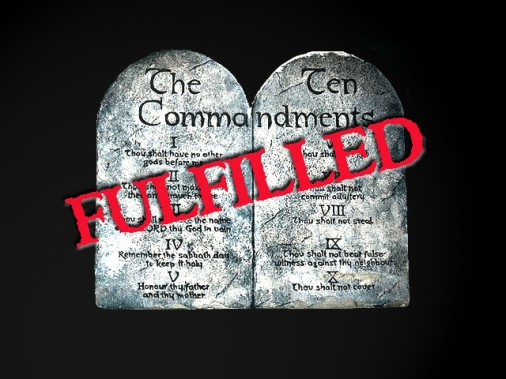
Yes, Jesus fulfilled the Law. Now the Law is fulfilled. What does it mean when something is fulfilled?

My father fulfilled the mortgage on his house. Now that his mortgage has been fulfilled, that mortgage is obsolete, fulfilled, finished, powerless. That’s what “fulfilled” means. It’s done.

So, yes, ALL of the terms and conditions of the Old Covenant (for that's what the law is) are now obsolete, fulfilled, finished, powerless, now that the Old Covenant is dead and gone.

The Torah (the first five books of the Bible, containing the Law of the Old Covenant) is an interesting (and useful) history book. It tells the story of a covenant that God never wanted, and that never worked [Acts 15:10]. We can learn from their mistakes, and we should.

But it is completely without merit as a standard to live by today, if for no other reason than there is nobody, literally not one body, who is still part of the Old Covenant to which the Law applies.

People try to say, “But obeying the Torah (or at least the 10 Commandments) is good. It’s part of making us acceptable to God.

Balderdash! Obeying the Law is an obstacle, a stumbling block to us becoming acceptable to God.

I am so thankful that the Law has been fulfilled! This is such an excellent expression of God’s mercy!

You see, it is not even possible to obey the Torah in our day and age, and it hasn’t been possible for nearly twenty centuries.

A huge part of the law was the sacrificial system. And nowadays, there is no ark of the covenant (it was lost centuries ago), there is no tabernacle or temple (it was destroyed many centuries ago) with an altar to kill bulls and goat on. And James says, "For whoever shall keep the whole law, and yet stumble in one point, he is guilty of all."

More importantly, there are no Levites left to offer those sacrifices to God. The Levites were the only ones whom the law allowed to do that. Even worse, there are no records of Levitical bloodlines, and without those records, nobody could minister if there was a temple.

All of the genealogical records (all of the documentation of who’s a Levite and who’s not) was destroyed when the Old Covenant was destroyed as the Temple was destroyed in the conquering of Jerusalem in the first century. [https://nwp.link/WikiAD70] There are many parts of the law that cannot be obeyed now, and stumbling in one point of the law makes you guilty of the whole thing. No wonder it was destroyed.

Scripture predicted that the Old Covenant was going to be done away with and the temple would be destroyed [Hebrews 8:13] and Jesus described it in detail [Matthew 24] a full generation before it went down. Literally, not one stone was left on another. (And because of his warnings, the Christians - the only ones who believed his warnings - escaped that destruction.)

Paul summarized this whole law business quite nicely: "I do not set aside the grace of God, for if righteousness could be gained through the law, Christ died for nothing!" [Galatians 2:21]

Does that mean that we live lives characterized by rebellion against the Law of the Old Covenant? Where the command is “Do not kill,” do we make murder our habit to lie in order to avoid an old, dead Law?

You can hear how silly that sounds when we see it in black and white. No, we still don’t kill people. But that's not because of the obsolete rule book of a failed covenant that never applied to anybody but Israel anyway.

Rather, we don’t kill because we’re like Jesus and he doesn’t kill. We don’t kill because he’s teaching us to “love one another as I have loved you,” and murdering people isn’t actually very loving.

So throw off the lies that say, “You must study the Torah! You must obey the Ten Commandments."

"Cast out the bondwoman and her son, for the son of the bondwoman shall not be heir with the son of the freewoman.” Cast out the efforts to obey as the way to please God. There is no inheritance for you in that path.
Standard
Letters

What Covenant?

Abraham believed God & God made a covenant with him. (Gen. 15:6 & 18) That covenant was based on the fact that Abe believed God. Now he’s God’s friend, as well as his covenant partner.

But in Genesis 12, Abe is afraid & lies about Sara. He was afraid the king would kill him to get his hands on his hot wife, so he says, “She’s my sister, not my wife!”

Abraham is giving in to a spirit of fear, and he’s a liar. Those are bad. But God backs him up, IN THE LIE! He defends Abraham (and his marriage) from the ignorant, horny kings.

Wait, what? God defends the liar? And defends the lie? Why would he do that?

It was hundreds of years later that Moses comes down the mountain with The Law, which includes “Don’t sleep with another man’s wife,” and “Don’t tell lies” and such. Now, with coming of The Law, adultery and lying (and several other things) become a sin.

The Law is a part of Moses’ covenant with God. It’s not part of Abraham’s covenant with God, or Noah’s.

In Abraham’s day, there was no rule that said “Don’t sleep with his wife,” and no rule that said, “Do not bear false testimony.” These rules didn’t show up until late in Moses’ life. They weren’t forbidden in Abraham’s day.

Were they still stupid things to do? Of course. And Abraham paid the price for that. But they weren’t “wrong” in Abe’s day and age.

So it’s not appropriate (or even meaningful) to judge Abraham or Noah by a covenant that didn’t exist in their day. In the same way, it’s not appropriate to judge a Peruvian farmer by Norway’s laws, or to judge a Mostho factory worker based on Peruvian law.

And The Law not actually part of our New Covenant either. Therefore, it’s completely inappropriate to judge New Covenant believers by Moses’ covenant. Or Noah’s covenant. Or any other covenant.

Are you a New Covenant believer? Then it’s completely inappropriate to judge yourself by Moses’ covenant either.


Standard
Letters

What Covenant?

Abraham believed God & God made a covenant with him. (Gen. 15:6 & 18) That covenant was based on the fact that Abe believed God. Now he’s God’s friend, as well as his covenant partner.

But in Genesis 12, Abe is afraid & lies about Sara. He was afraid the king would kill him to get his hands on his hot wife, so he says, “She’s my sister, not my wife!”

Abraham is giving in to a spirit of fear, and he’s a liar. Those are bad. But God backs him up, IN THE LIE! He defends Abraham (and his marriage) from the ignorant, horny kings.

Wait, what? God defends the liar? And defends the lie? Why would he do that?

It was hundreds of years later that Moses comes down the mountain with The Law, which includes “Don’t sleep with another man’s wife,” and “Don’t tell lies” and such. Now, with coming of The Law, adultery and lying (and several other things) become a sin.

The Law is a part of Moses’ covenant with God. It’s not part of Abraham’s covenant with God, or Noah’s.

In Abraham’s day, there was no rule that said “Don’t sleep with his wife,” and no rule that said, “Do not bear false testimony.” These rules didn’t show up until late in Moses’ life. They weren’t forbidden in Abraham’s day.

Were they still stupid things to do? Of course. And Abraham paid the price for that. But they weren’t “wrong” in Abe’s day and age.

So it’s not appropriate (or even meaningful) to judge Abraham or Noah by a covenant that didn’t exist in their day. In the same way, it’s not appropriate to judge a Peruvian farmer by Norway’s laws, or to judge a Mostho factory worker based on Peruvian law.

And The Law not actually part of our New Covenant either. Therefore, it’s completely inappropriate to judge New Covenant believers by Moses’ covenant. Or Noah’s covenant. Or any other covenant.

Are you a New Covenant believer? Then it’s completely inappropriate to judge yourself by Moses’ covenant either.


Standard
Letters

The Controversial Source of the Law.

God offered, “You [Israel] will be for me a kingdom of priests and a holy nation.” (Exodus 19:6) God offered a covenant of equals: you and me, face to face with God with nothing in between. Peers.

They rejected his offer, and counter-offered, “Speak to us yourself and we will listen. But do not have God speak to us or we will die.” (Exodus 20:19)


They proposed the intermediary, which is what a priesthood is. And they promised to listen. The original language contains a hint of obedience, but no, this isn’t an express promise (which was probably good).

They rejected the peer relationship, the covenant of equals, and they substituted a vertical relationship: big god with the rules (and therefore the spank stick), and the only way to know him is through a priest. Ick.

So the idea of a priesthood was not God’s idea, but the people’s. And the idea of hearing and obeying rules wasn’t God’s idea, but the people’s. He wanted a face-to-face with every living being, but they threw that back in his face and demanded a priesthood and rules.

So God was backed into a corner: either relate to people through a priesthood and rules, or walk away, wipe his hands clean and start over again.

But he’s not One to walk away.

So he submitted his mighty self to their silly little demands. It was better than no relationship at all.

They wanted a priesthood: Moses started it with Aaron, and it continued on. That’s what Leviticus is all about. Don’t you love Leviticus? Isn’t it fun to read?

They wanted rules. So God gave them a handful. Those rules were never about “Do this and you go to Heaven.” They were “Do this and you won’t get spanked.” (see Deuteronomy 30, and Luke 10:28). “Do this and you won’t be cursed.”

But they broke covenant before the rules were even delivered (remember the golden calf?). Then came more rules. And they failed those, so he had to give them other rules, more specific rules.

If you have rules, then you need to have an enforcer, and that is ALWAYS your god. So God was party to a covenant he didn’t want, and was the enforcer if the people didn’t keep their end of the covenant.

No wonder God was glad to be rid of that covenant. “By calling this covenant “new,” he has made the first one obsolete; and what is obsolete and outdated will soon disappear.” (Hebrews 8:13)  He never wanted the stinky old rules or the silly little priesthood in the first place.


Standard
Letters

The Controversial Source of the Law.

God offered, “You [Israel] will be for me a kingdom of priests and a holy nation.” (Exodus 19:6) God offered a covenant of equals: you and me, face to face with God with nothing in between. Peers.

They rejected his offer, and counter-offered, “Speak to us yourself and we will listen. But do not have God speak to us or we will die.” (Exodus 20:19)


They proposed the intermediary, which is what a priesthood is. And they promised to listen. The original language contains a hint of obedience, but no, this isn’t an express promise (which was probably good).

They rejected the peer relationship, the covenant of equals, and they substituted a vertical relationship: big god with the rules (and therefore the spank stick), and the only way to know him is through a priest. Ick.

So the idea of a priesthood was not God’s idea, but the people’s. And the idea of hearing and obeying rules wasn’t God’s idea, but the people’s. He wanted a face-to-face with every living being, but they threw that back in his face and demanded a priesthood and rules.

So God was backed into a corner: either relate to people through a priesthood and rules, or walk away, wipe his hands clean and start over again.

But he’s not One to walk away.

So he submitted his mighty self to their silly little demands. It was better than no relationship at all.

They wanted a priesthood: Moses started it with Aaron, and it continued on. That’s what Leviticus is all about. Don’t you love Leviticus? Isn’t it fun to read?

They wanted rules. So God gave them a handful. Those rules were never about “Do this and you go to Heaven.” They were “Do this and you won’t get spanked.” (see Deuteronomy 30, and Luke 10:28). “Do this and you won’t be cursed.”

But they broke covenant before the rules were even delivered (remember the golden calf?). Then came more rules. And they failed those, so he had to give them other rules, more specific rules.

If you have rules, then you need to have an enforcer, and that is ALWAYS your god. So God was party to a covenant he didn’t want, and was the enforcer if the people didn’t keep their end of the covenant.

No wonder God was glad to be rid of that covenant. “By calling this covenant “new,” he has made the first one obsolete; and what is obsolete and outdated will soon disappear.” (Hebrews 8:13)  He never wanted the stinky old rules or the silly little priesthood in the first place.


Standard
Letters

Fulfilling the Law and the Prophets

Abolish is a strong word.

People quote Matthew 5:17&18 at me, to say “See! We still need to be under the Law! Look! See!”

These verses reads, “Do not think that I came to abolish the Law or the Prophets; I did not come to abolish but to fulfill. For truly I say to you, until heaven and earth pass away, not the smallest letter or stroke shall pass from the Law until all is accomplished.”

I have to admit, if you grab that verse, yank it out of its context, ignore the bit about the Prophets, and try to use it as a club to support a need for the Law (or at least the 10 Commandments), then it kind of fits. If you squint.

Let’s look at this a little more closely, a little more objectively, shall we? Is Jesus really saying, “Psych! I’m not really freeing you from the Law!”? Or is Jesus saying something else.


That “Something else” could be several things:

  1. Perhaps the context tells us some things?
  2. There may be a Jewish metaphor here that we’re not catching because we’re not first century Jews. That might change the meaning here.  
  3. He might be talking about a purpose of the Law and the Prophets that he’s going to fulfill.
  4. He might be talking about and end of the Law, but one that is not His doing.
Let’s look at these possibilities one by one.

1. First, what does the context tell us? This is in the middle of a sermon where Jesus is completely re-interpreting their understanding of the Law. The entire chapter is about Jesus saying, “You’ve heard the Law taught this way…. But I tell you this other thing instead.”

So it’s not reasonable to assume that this is about submitting to the Law, at least not without some more evidence to work with. It’s more reasonable to infer that Jesus is doing away with how that Jewish culture has always understood the Law, and replacing that with a completely new understanding. 

2. Is there a Jewish metaphor here? I’m glad you asked. Yes there is. Jesus says the Law is valid “until heaven and earth pass away.” Well, when is that?

We, in our 21st century, science-based world interpret that literally, and if Jesus were speaking on CNN or the Discover Channel, that would probably be a reasonable interpretation. But that is not how his audience at the time would interpret it, so it’s not permitted for us to impose a 21st century interpretation onto this first century document.

If you look at the phrase in scripture (http://nwp.link/2idn9Ml), it’s used more than 120 times (NKJV). In general, the words are used together to describe “Pretty much everything we know” (which was *much* less than what we know today!), but when used together, it’s specifically addressing the abode of God (see: http://nwp.link/2j2nNR5, especially Isaiah 66:1 and Jeremiah 23:24).

In fact, this view was so prevalent that eventually the temple and its courtyard in Jerusalem became known as “Heaven and Earth,” and was spoken of as immovable. The temple itself, the “dwelling place of God” was Heaven, and the courts, particularly with the court of Gentiles, was “the Earth. In more poetical language, it was described as “Where Heaven and Earth meet.” (https://utpress.utexas.edu/books/grawhe)

3. The structure of the sentence clearly points to the fulfillment of “The Law and the Prophets.” We’ve taught for generations (correctly) that the Law and the Prophets point to Jesus, and this passage in Matthew has been part of that teaching. Certainly, the reference to “the Prophets” would not be part of a declaration of keeping the Old Covenant Law.

These verses are clearly saying that the Law was still in place as Jesus made the statement; it hadn't been fulfilled yet. Recently, I fulfilled my obligations on a loan. Until that loan was fulfilled, I kept making payments. If I missed even one payment, maybe the last payment, then the loan was in default, and the bank had the right to seize my property and sell it off to cover that payment.

But when I fulfilled that loan, when the payments were done, then the loan no longer has any power over my behavior (“Payments are due!”) or consequences (“…or we’ll seize your stuff!”). I was now free from that law.

4. The Old Covenant Law was still in place when Jesus spoke these words about the Law being fulfilled. It was already “obsolete and growing old is ready to vanish away,” (Hebrews 8:13), but it didn’t finally “vanish away” until the last possible second: exactly one generation (40 years) after Jesus’ death, when the Jerusalem, the temple (“Heaven & Earth”) and perhaps most significantly, the genealogical records of Israel were all destroyed. Without those records, it was impossible to determine who was a descendant of Aaron, and therefore qualified to be a priest and to make the sacrifices the Law demanded.

When Jerusalem was destroyed in 70AD (a description of which is in Matthew 24, in answer to the question of “When will the stones of the temple be thrown down?”), the Old Covenant finally breathed its last and died, completely fulfilled in Christ.

So these verses are not a statement that Believers need to keep the Old Covenant Law. They were a warning that while the Law was still in force when the words were spoken, that Law would end soon. Romans is blunt: “For Christ is the end of the law for righteousness….” Done.

And Jesus didn't just end Ten Commandments. He ended 613 laws; he ended all of them. All of that is dead. It was obsolete. It wasn’t needed any more.

You see, all of those commandments were the "terms and conditions" for the Old Covenant. And he ended the Old Covenant. (The Epistle to the Hebrews describes it pretty well, better than this article has room for.)

So when that broken down, obsolete covenant was replaced with a New Covenant, the terms and conditions of the first covenant (all those laws, and the priesthood, and the sacrifices) were all replaced with the terms and conditions of the New Covenant as well.


So anyone who names the name of Christ is not under the Old Covenant, and not obligated – not even a smidgeon – to the terms and conditions of that obsolete covenant. We share in a New Covenant, and no man can serve two masters. 
Standard
Letters

Fulfilling the Law and the Prophets

Abolish is a strong word.

People quote Matthew 5:17&18 at me, to say “See! We still need to be under the Law! Look! See!”

These verses read, “Do not think that I came to abolish the Law or the Prophets; I did not come to abolish but to fulfill. For truly I say to you, until heaven and earth pass away, not the smallest letter or stroke shall pass from the Law until all is accomplished.”

I have to admit, if you grab that verse, yank it out of its context, ignore the bit about the Prophets, and try to use it as a club to support a need for the Law (or at least the 10 Commandments), then it kind of fits. If you close one eye and squint the other. 

Let’s look at this a little more closely, a little more objectively, shall we? Is Jesus really saying, “Psych! I’m not really freeing you from the Law!”? Or is Jesus saying something else.

That “Something else” could be several things:

  1. Perhaps the context tells us some things?
  2. There may be a Jewish metaphor here that we’re not catching because we’re not first century Jews. That might change the meaning here.  
  3. He might be talking about a purpose of the Law and the Prophets that he’s going to fulfill.
  4. He might be talking about and end of the Law, but one that is not His doing. 
Let’s look at these possibilities one by one.

1. First, what does the context tell us? This is in the middle of a sermon where Jesus is completely re-interpreting their understanding of the Law. The entire chapter is about Jesus saying, “You’ve heard the Law taught this way…. But I tell you this other thing instead.”

So it’s not reasonable to assume that suddenly he breaks his train of thought and talks about submitting to the Law, at least not without some more evidence to work with. It’s more reasonable to infer that Jesus is doing away with how that Jewish culture has always understood the Law, and replacing that with a completely new understanding. That is the context.

2. Is there a Jewish metaphor here? I’m glad you asked. Yes there is. Jesus says the Law is valid “until heaven and earth pass away.” Well, when is that?

We, in our 21st century, science-based world interpret that literally, scientifically, and if Jesus were speaking on CNN or the Discover Channel, that would probably be a reasonable interpretation. But that is not how his audience at the time would interpret it. So it’s not permitted for us to impose a 21st century interpretation onto this first century document.

If you look at the phrase in scripture (http://nwp.link/2idn9Ml), it’s used more than 120 times (NKJV). In general, the words are used to describe “Pretty much everything we know” (which was *much* less than what we know today!), but when used together, it’s specifically addressing the abode of God (see: http://nwp.link/2j2nNR5, especially Isaiah 66:1 and Jeremiah 23:24). This is describing the Jewish temple. 

In fact, this view was so prevalent that eventually the temple and its courtyard in Jerusalem became known as “Heaven and Earth,” and was spoken of as immovable. The temple itself, the “dwelling place of God” was Heaven, and the courts, particularly with the court of Gentiles, was “the Earth. In more poetical language, it was described as “Where Heaven and Earth meet.” (https://utpress.utexas.edu/books/grawhe)

So the Law and the Prophets are still valid, under Jesus’ new interpretation, until the temple was destroyed. That’s what it meant to the writer and the original readers of the Gospels. We cannot impose our 21st century cosmology onto the text.

3. The structure of the sentence clearly points to the fulfillment of “The Law and the Prophets.” We’ve taught for generations (correctly) that the Law and the Prophets point to Jesus, and this passage in Matthew has been part of that teaching. Certainly, the reference to “the Prophets” would not be part of a declaration of keeping the Old Covenant Law.

These verses are clearly saying that the Law was still in place as Jesus made the statement; it hadn’t been fulfilled yet. Recently, I fulfilled my obligations on a loan. Until that loan was fulfilled, I kept making payments. If I missed even one payment, even the very last payment, then the loan was in default, and the bank had the right to seize my property and sell it off to cover my failure. 

But when I fulfilled that loan, when the payments were done, then the loan no longer has any power over my behavior (“Payments are due!”) or consequences (“…or we’ll seize your stuff!”). I was now free from that law. 

Jesus was declaring that the fulfillment of everything the Law and the Prophets spoke about was upon them: they were about to see the realization of everything they’d been waiting for for the last couple of millennia!

4. The Old Covenant Law was still in place when Jesus spoke these words about the Law being fulfilled. It was already “obsolete and growing old is ready to vanish away,” (Hebrews 8:13), but it didn’t finally “vanish away” until the last possible second: exactly one generation (40 years) after Jesus’ death, when the Jerusalem, the temple (“Heaven & Earth”) and perhaps even most significantly, the genealogical records of Israel were all destroyed. Without those records, it was impossible to determine who was a descendant of Aaron, and therefore qualified to be a priest and to make the sacrifices the Law demanded. Legitimate sacrifices could never be re-instituted.

When Jerusalem was destroyed in 70AD (a description of which is in Matthew 24, in answer to the question of “When will the stones of the temple be thrown down?”), the Old Covenant finally breathed its last and died, completely fulfilled in Christ.

So these verses are not a statement that Believers need to keep the Old Covenant Law. They were a warning that while the Law was still in force when the words were spoken, but that Law would end soon. Romans is blunt: “For Christ is the end of the law for righteousness….” Done.

And Jesus didn't just end Ten Commandments. He ended 613 laws; he ended all of them. All of that is dead. It was obsolete. It wasn’t needed any more.

You see, all of those commandments were the "terms and conditions" for the Old Covenant. And Jesus ended the Old Covenant. (The Epistle to the Hebrews describes that termination pretty well, better than this article has room for.)

So when that broken down, obsolete covenant was replaced with a New Covenant, the terms and conditions of the first covenant (all those laws, and the priesthood, and the sacrifices) were all replaced with the terms and conditions of the New Covenant as well.

So anyone who names the name of Christ is not under the Old Covenant, and not obligated – not even a smidgeon – to the terms and conditions of that obsolete covenant. We share in a New Covenant, and no man can serve two masters. Dont try.
Standard